

The People Who Made Us
This Hispanic Heritage Month, three CFI team members share personal reflections on the families, communities and cultures that shaped their lives and helped build Colorado.
 EN
EN

One of the often-used arguments against raising taxes on high-income earners, like Colorado’s Initiative 195, is that higher taxes on upper-income households will trigger an exodus of wealthy taxpayers to Florida, where they will apparently spend the rest of their lives keeping the pickleball industry solvent and explaining to their neighbors that they used to live somewhere with mountains.
Economist: “The data suggest migration effects are very small.”
Internet commenter: “Wrong. My dentist’s cousin moved to Naples.”
Economist: “The sensitivity to …”
Internet commenter: (interrupting) “Checkmate.”
We don’t have to speculate. Economists have spent decades studying this question, and CFI’s research explainer examines the evidence from Colorado and across the country. One of the most comprehensive studies looked at every millionaire tax return in America from 1999 to 2011.
The researchers found that millionaires do show some sensitivity to tax rates, but it’s much smaller than most people imagine. When they move, they’re somewhat more likely to move toward lower-tax states. But millionaires are not especially mobile in the first place. Their annual migration rate was only about 2.4%, which is lower than that of the general population.
Another study examined New Jersey’s 2004 millionaire tax, which raised rates on top earners by 2.6 percentage points to 8.97%. The study found a slight uptick in the number of millionaires who left New Jersey, resulting in the loss of $16 million in tax revenue, but the state gained $1 billion from those who remained. Put differently, the revenue loss from supposed wealth flight was less than 2% of the revenue gained.
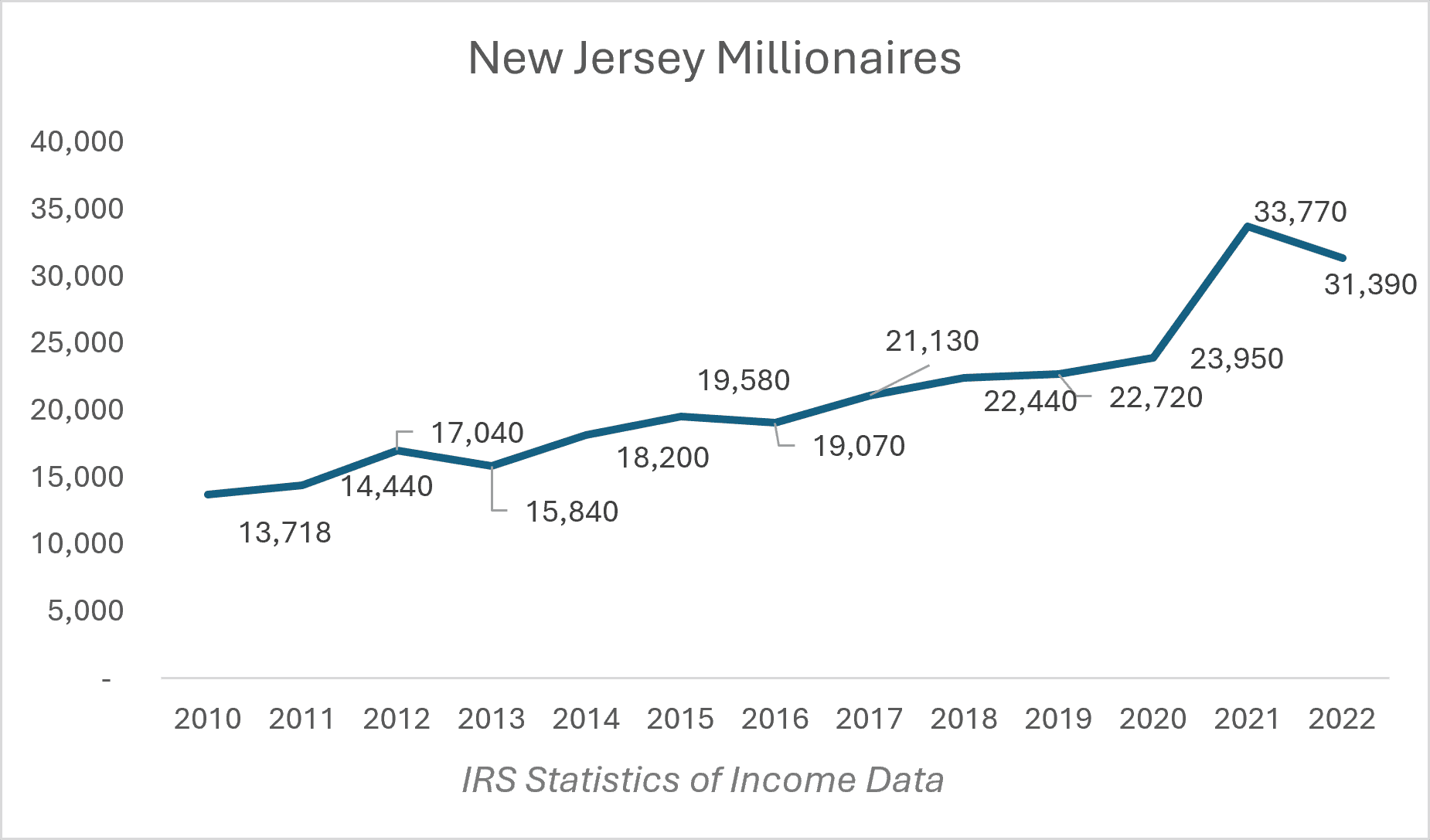
Fortunately, you don’t need access to proprietary IRS microdata or a Ph.D. that allows you to use statistical terms like “heteroskedasticity” and “adjusted R-squared” without frightening children. The number of millionaires in each state is publicly available. Here’s the number of New Jersey millionaires.
In 2020, New Jersey raised the rate on income between $1 million and $5 million from 8.97% to 10.75%. Income above $5 million was already taxed at 10.75%. The following year, the number of New Jersey millionaires increased by 41%.
Recently, we got one of the strongest pieces of evidence on whether high-income taxes cause wealthy households to leave. And it came not from a state tax increase, but from the federal Tax Cuts and Jobs Act of 2017. The study examined how tax incentives and people’s ties to their communities shaped millionaire migration.
Normally, it’s difficult to isolate the effect of taxes on migration because high-tax and low-tax states differ in countless ways: weather, housing costs, labor markets, politics, demographics and whether the local wildlife can kill you. If someone moves from New York to Florida, did they flee the taxes, or did they finally decide that scraping ice off a windshield builds absolutely no character?
The Tax Cuts and Jobs Act largely solved that problem by creating a natural experiment. Congress changed one thing nationwide: It capped the federal deduction for state and local taxes, known as the SALT deduction. No state changed its own income tax law, but the after-tax cost of living in high-tax states increased overnight.
The change dramatically increased the tax incentive to move. Before the law took effect, a millionaire paying $100,000 in California income taxes could deduct most of that payment on a federal return, reducing its effective cost. After the SALT write-off was capped at $10,000, taxpayers in high-tax states bore nearly the full cost of their state taxes, while residents of states without an income tax, like Florida and Texas, lost little or nothing. The result widened the effective tax difference between high-income-tax states and states without an income tax by about 3.1 percentage points. For someone earning $2 million a year, that increased the financial incentive to relocate by roughly $60,000 annually. If taxes truly drove large-scale millionaire migration, this should have been the moment it happened.
Instead, researchers found remarkably little movement. The effect of tax rates was tiny: A 1-percentage-point increase in tax differences reduced a state’s millionaire population by only about 0.2% to 0.3%. California lost only about 380 millionaires out of roughly 81,000 because of the SALT cap, or about 0.5% of its millionaire population.
It turns out that most affluent households are not simply maximizing tax savings. They are anchored by businesses, spouses, children, social networks and careers built in a specific place, what economists call “elite embeddedness.” They’re not spending their weekends scrolling Zillow and muttering, “Honey, I found a state that saves us 2% and only requires us to abandon our company, friends, clients, golf foursome and grandchildren.”
For Colorado’s Initiative 195, which would raise rates on taxable income above $500,000, this study provides an important benchmark. The Tax Cuts and Jobs Act created an interstate tax incentive yet produced only modest changes in millionaire migration. If a nationwide policy change that cost a person earning $2 million roughly $60,000 per year forced only 0.5% of California millionaires to leave, fears of large-scale tax flight should be viewed with considerable caution.
If Colorado experienced the same effect under Initiative 195, the state would lose about 100 of its roughly 20,000 millionaires, just 0.5%. In other words, about 19,900 would stay put, anchored by businesses, families, golf foursomes and their dentist whose cousin insists everyone is moving to Florida. Plus, the additional taxes they pay would fund child care, health care and schools.
The findings are consistent with CFI’s broader review of tax flight research: Higher taxes may cause some high-income taxpayers to leave, but not enough to erase most of the additional revenue states collect.