A clear guide to what Amendment 87 would change, what it would leave alone and what the research says. Explore CFI’s analysis of the measure’s effects on taxpayers, seniors, veterans, small businesses, TABOR and Colorado’s economy.

For years, CFI has worked with partners across Colorado to fight for a tax system that better reflects our values, asks more of those with the greatest ability to pay and gives working families a fairer deal. That work helped bring Amendment 87 to the ballot this year. Through Protect Colorado’s Future, we’re proud to stand alongside advocates and organizations across the state pushing for a tax code that invests in our communities and works better for everyone, not just the highest earners.

What is Amendment 87

Amendment 87 would replace the state’s flat income tax with a graduated income tax. It would lower income tax rates on the first $100,000 of taxable income, keep the current rate on income between $100,000 and $500,000 and raise rates on taxable income above $500,000. The state’s official analysis estimates that 97% of taxpayers would receive an income tax cut.

There are a lot of claims flying around about what Amendment 87 would mean for seniors, veterans, small businesses, TABOR refunds and Colorado’s economy. You may have seen them in an ad, mailer, text message or your group chat.

Those are questions worth checking. So we did what we do: looked at the numbers.

We reviewed the underlying tax rules, census data, state revenue data, official fiscal analyses and research on what happened when other states changed taxes on high incomes. This page breaks down what Amendment 87 actually changes, what it does not change and what the research says about some of the claims you may be hearing.

You do not have to take anybody’s political message at face value. Look at the numbers, check the sources and decide for yourself. For more information about Amendment 87 and the coalition supporting it, visit ProtectColoradosFuture.com.


Higher tax rates begin on income above $500,000. But because Amendment 87 also cuts the rates on the first $100,000, the state’s official analysis finds that a taxpayer would not actually begin paying more overall until they reach about $510,834 in Colorado taxable income.

And these are marginal rates. If you cross into a higher bracket, that rate applies only to the income inside that bracket, not every dollar you earn.
How Amendment 87 Would Change Colorado’s Income Tax Rates
Colorado Taxable Income Current Rate Amendment 87 Rate
$25,000 or less 4.4% 3.7%
$25,001 to $100,000 4.4% 4.2%
$100,001 to $500,000 4.4% 4.4%
$500,001 to $750,000 4.4% 7.4%
$750,001 to $1,000,000 4.4% 7.9%
$1,000,000 or more 4.4% 8.4%

For the overwhelming majority of seniors, no.

99.5% of Coloradans age 65 or older had personal income below $500,000 in 2024, according to CFI’s analysis of American Community Survey data.

What Amendment 87 does not change:

  • Social Security tax treatment
  • Existing pension and annuity subtractions
  • Existing deductions and exemptions
  • The rules used to calculate Colorado taxable income

Amendment 87 changes the tax rates applied after taxable income is calculated. It does not suddenly make previously untaxed retirement income taxable.

Amendment 87 changes Colorado’s income tax rates; it does not eliminate the deductions and subtractions Colorado already provides for Social Security, pensions and qualifying military retirement benefits.

For example, imagine a 68-year-old retiree receives $40,000 in Social Security benefits. Colorado law allows taxpayers age 65 and older to subtract all of their federally taxable Social Security benefits when calculating Colorado taxable income. Amendment 87 does not change that subtraction. If that Social Security income is excluded from Colorado taxable income today, changing the tax rate applied to taxable income does not suddenly make those excluded dollars taxable.

Bottom line

If income is not included in your Colorado taxable income today, Amendment 87 does not make it taxable simply because the tax rates change.

Sources: U.S. Census Bureau, 2024 American Community Survey and Colorado Department of Revenue guidance on Social Security, pensions and annuities.

For the overwhelming majority of veterans, no.

CFI’s analysis of 2024 American Community Survey data found:

361,600 of approximately 364,500 Colorado veterans, or 99.2%, had personal income at or below $500,000.

Amendment 87 also does not eliminate Colorado’s existing tax treatment for qualifying military retirement income.

The measure changes the rates applied to taxable income. It does not change the underlying rules determining what counts as taxable income.

Bottom line

Nearly all Colorado veterans fall below the income level where Amendment 87’s higher rates begin, and the measure does not eliminate existing military retirement tax provisions.

Source: U.S. Census Bureau, 2024 American Community Survey.

No.

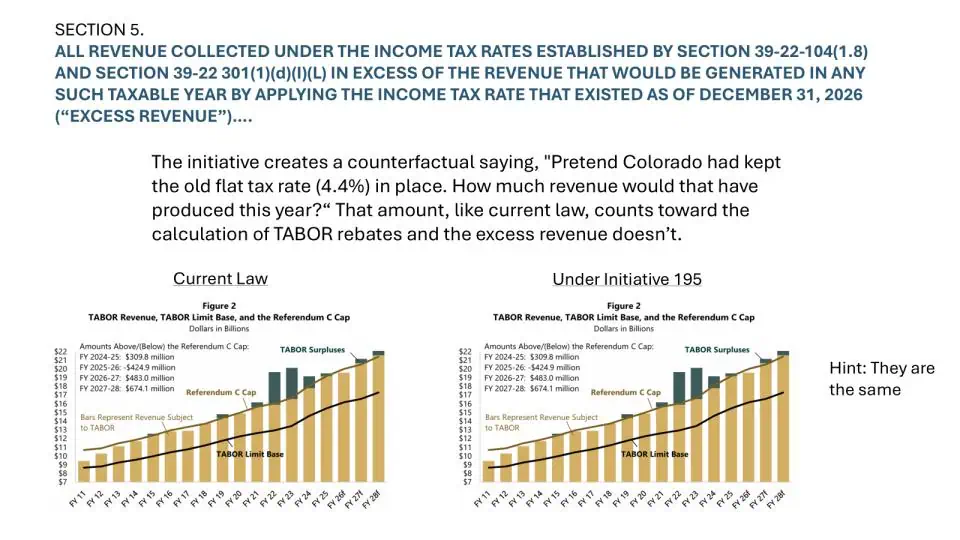
The state’s official analysis says Amendment 87 would have no impact on current TABOR refunds or the mechanisms used to calculate them.

Here’s how it works:

Revenue Colorado would have collected under the existing tax system:
Still counts toward the TABOR limit.

Additional revenue created by Amendment 87:
Exempt from the TABOR limit and dedicated to the purposes listed in the measure.

Bottom line

Amendment 87 changes one part of TABOR, the requirement that taxable income be taxed at one rate. It does not repeal TABOR or eliminate the existing refund system. A tax filer can expect between $43 to $137 in TABOR rebates in 2027 whether Amendment 87 passes or not.


Side-by-side charts compare current law with Amendment 87 and show that the TABOR revenue limit and refund calculations remain the same. A note explains that revenue that would have been collected under the current 4.4% flat tax still counts toward TABOR, while only the additional revenue raised above that amount is exempt.

Researchers found that millionaires do show some sensitivity to tax rates, but it’s much smaller than most people imagine. When they move, they’re somewhat more likely to move to lower-tax states. But millionaires are not especially mobile in the first place. Their annual migration rate was only about 2.4%, lower than that of the general population.

Another study examined New Jersey’s 2004 millionaire tax, which raised rates on top earners by 2.6 percentage points, to 8.97%. The study found a slight uptick in the number of millionaires who left New Jersey, resulting in the loss of $16 million in tax revenue, but the state gained $1 billion from those who remained. Put differently, the revenue loss from supposed wealth flight was less than 2% of the revenue gained.

The 2017 Tax Cuts and Jobs Act created a natural experiment by capping the federal deduction for state and local taxes, or SALT, at $10,000. This widened the effective tax difference between high-tax states and states without income taxes by about 3.1 percentage points, creating a substantial financial incentive for millionaires to relocate. For someone earning $2 million a year, that increased the financial incentive to relocate by roughly $60,000 annually. If taxes truly drove large-scale millionaire migration, this should have been the moment it happened.

Yet researchers found very little migration in response. A 1-percentage-point increase in tax differences reduced a state’s millionaire population by just 0.2% to 0.3%. California lost an estimated 380 millionaires out of 81,000, or roughly 0.5% of its millionaire population. The findings suggest that millionaires are far less responsive to state income taxes than commonly claimed, largely because their businesses, careers, families and social networks tie them to where they live.

It turns out millionaires also like places with strong economies, including educated workforces, quality public services and infrastructure. They are, and have remained, concentrated in states with the highest taxes. From 2010 to 2023, states with millionaire taxes, along with Washington, D.C., went from having an average of 1.2 more millionaires than the country as a whole to 2.3 more.

Bottom line

Higher taxes may cause a small number of wealthy households to move, but research does not show the large-scale “wealth flight” often predicted when states raise taxes on very high incomes. States with higher taxes on millionaires have still seen their millionaire populations grow.

Source: Young and Lurie, 2025; Kleven et al., 2020; Massachusetts Budget and Policy Center, 2026; Maine Center for Economic Policy, 2026.


Most would receive a tax cut.

There are about 730,887 small businesses in Colorado, representing 99.5% of businesses in the state. But “small business” describes the size of a business, not how it pays income taxes.

Business Types and How They’re Taxed in Colorado
Business Type How Income Is Taxed What Matters Under Amendment 87
Pass-through business Business income passes through to the owner’s personal tax return The business owner’s taxable income
C corporation The corporation files its own income tax return The corporation’s taxable income

Key numbers

  • 95% of businesses are estimated to pay less under Amendment 87.
  • In 2024, 98% of Coloradans reporting positive self-employment income had personal income below $500,000.
  • For pass-through businesses, higher rates would apply only if the owner’s taxable income reaches the higher brackets.
  • For C corporations, the same graduated rate structure applies to the corporation’s taxable income, not its gross sales.

Bottom line

Most small businesses fall below the income level where higher tax rates begin, but how Amendment 87 affects a business depends on how that business is taxed.

Sources: Colorado Office of Economic Development and International Trade; U.S. Census Bureau, 2024 ACS microdata; Bell Policy Center analysis

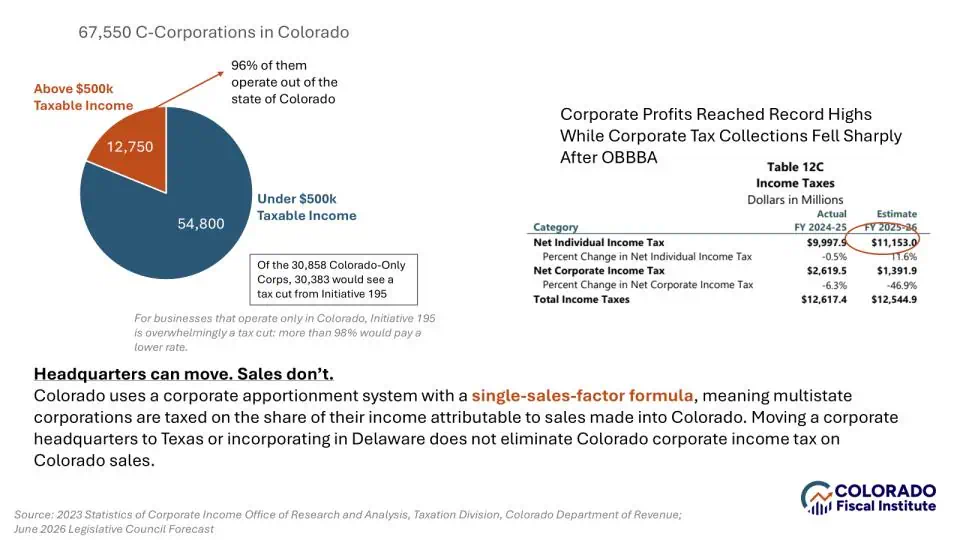
Graphic showing 67,550 C corporations in Colorado. A pie chart shows 54,800 with taxable income under $500,000 and 12,750 above $500,000. A note says 96% of corporations above $500,000 operate outside Colorado. The graphic also explains that Colorado uses a single-sales-factor formula, so multistate corporations are taxed based on sales made in Colorado, regardless of where they are headquartered.

Because Amendment 87 uses marginal brackets, these lower rates apply to the first portions of taxable income for everyone, not just taxpayers earning less than $100,000.

Bottom line

The state’s official analysis estimates that 97% of taxpayers would receive a tax cut.

Because $500,000 is where the higher marginal bracket begins.

But taxpayers also receive the lower rates Amendment 87 creates on their first $100,000 of taxable income. Those savings offset the higher rate on the first dollars above $500,000. The result:

$500,000
Higher marginal rate begins.

$510,834
Approximate point where the taxpayer's total state income tax becomes higher than under current law.

Bottom line

The bracket starts at $500,000. The overall tax increase starts around $510,834.


The brackets are not automatically indexed to inflation.

That means nominal income growth could cause more income to fall into higher brackets over time.

But that does not mean a typical middle-income taxpayer is about to hit the $500,000 bracket.

Campaign analysis estimates that at 3% annual inflation, it would take more than 50 years for a taxpayer earning $100,000 today to reach another bracket solely through nominal income growth.

Research underway

CFI is conducting additional analysis of bracket creep and the long-term effect of inflation on Amendment 87’s brackets. This section will be updated when that analysis is complete.

About $2 billion annually in a full fiscal year under the current state forecast.

You may also see $2.7 billion associated with Amendment 87. These numbers describe different things.

Figure

What it means

Up to $2.7 billion

Maximum annual tax increase stated in the ballot title

$958.4 million

Legislative Council estimate for FY 2026-27

$1.972 billion

Estimate for FY 2027-28

$2.086 billion

Estimate for FY 2028-29

Bottom line

$2.7 billion is the maximum stated in the ballot title. Current nonpartisan forecasts estimate collections closer to $2 billion in a full fiscal year.

Read the Legislative Council Staff fiscal analysis.

Revenue raised by Amendment 87 is not a blank check for politicians. The measure restricts the new revenue to three areas:

  • K-12 public education
  • Health care
  • Early childhood care and education

The money must be kept in a separate fund and is subject to accountability requirements, including annual reporting and an independent audit.

Why does Colorado need additional revenue?

Colorado is facing growing budget pressure even before accounting for all of the new costs being shifted to the state.

The September 2026 revenue forecast showed that Colorado could be about $1.58 billion short of its required reserve in fiscal year 2027-28 after accounting for obligations under current law. Those pressures include rising Medicaid costs, school finance, capital spending and other existing commitments.

Federal policy changes are adding to that strain. H.R. 1 shifted new costs for programs including SNAP and Medicaid onto states. CFI has estimated that Colorado could face roughly $130 million in new SNAP costs, while restrictions affecting federal Medicaid funding could create an additional $105 million General Fund obligation that could grow substantially over time. 

New Medicaid work requirements also create administrative burdens and costs for states while putting coverage at risk for people who may struggle to navigate reporting requirements.

Learn more about Colorado’s budget challenges:


Research and Sources

Amendment 87 and Colorado tax policy

Colorado Legislative Council Staff: 2026 State Ballot Information Booklet

Colorado Legislative Council Staff: Amendment 87

Colorado Legislative Council Staff: 2026 Fiscal Impact Statements

Ballotpedia: Colorado Amendment 87

Wealth migration and taxes

Young, Cristobal, and Ithai Z. Lurie. “Taxing the Rich: How Incentives and Embeddedness Shape Millionaire Tax Flight.” American Journal of Sociology, 2025.

Young, Cristobal, Charles Varner, Ithai Z. Lurie, and Richard Prisinzano. “Millionaire Migration and Taxation of the Elite: Evidence from Administrative Data.” American Sociological Review 81, no. 3 (2016): 421-446.

Abreu-Hernández, Viviana. “New IRS Migration Data Shows No Evidence of Surtax-Driven Outmigration, Highlights Affordability Challenges.” Massachusetts Budget and Policy Center, 2026.

Shaffer, Mark. “IRS Data Shows Maine Is Gaining Residents From So-Called ‘Low Tax’ States.” Maine Center for Economic Policy, 2026.

Moretti, Enrico, and Daniel J. Wilson. “Taxing Billionaires: Estate Taxes and the Geographical Location of the Ultra-Wealthy.” American Economic Journal: Economic Policy, 2023.

Kleven, Henrik J., Camille Landais, Mathilde Muñoz, and Stefanie Stantcheva. “Taxation and Migration: Evidence and Policy Implications.” Journal of Economic Perspectives, 2020.

Perry, Andrew, and Cristobal Young. “States With Progressive Tax Systems Are the Most Millionaire Friendly.” Fiscal Policy Institute, 2026.

Mazerov, Michael. “State Taxes Have a Minimal Impact on People’s Interstate Moves.” Center on Budget and Policy Priorities, 2023.

Businesses and household data

Colorado Office of Economic Development and International Trade: Colorado Small Business Data

U.S. Census Bureau: 2024 American Community Survey Public Use Microdata

Colorado Department of Revenue, 2023 Statistics of Income: C Corporations. 

Bell Policy Center analysis of Amendment 87 business tax impacts. 

Retirement income

Colorado Department of Revenue: Social Security, Pensions, and Annuities

Ballot Guides

See our yearly voting resources and ballot guides.

Voter Resources

Count Me In

See our nonpartisan, objective ballot education resource, Count Me In! for reliable, plain-language information on every measure on the ballot. Count Me In is a robust civic engagement effort that partners with communities across the state to share resources on the decisions they will see on their ballots. Our focus is to spark community conversations about the power we have to influence the public investments that shape our communities.

Just Vote Colorado

Visit Just Vote Colorado to find answers to frequently asked questions, learn about your voting rights and more. Call the Election Protection hotline (866-OUR-VOTE) or NALEO’s Spanish-speaking voter hotline (888-VE-Y-VOTA) for additional assistance or to report issues. Help is available in 11 languages including ASL. Just Vote Colorado Election Protection is a non-partisan voter assistance project and is not affiliated with or promoting any party, candidate, or ballot issue.

Go Vote Colorado | Colorado Secretary of State

You can register to vote in Colorado all the way up to and on Election Day. Register online, check or update your registration, and find a polling place at Go Vote Colorado.

More questions? Reach out to Caitlin Schneider, schneider@coloradofiscal.org, for research requests or to schedule a presentation.

CFI's Ballot Corner

Explore Our Latest Guides, Reports, and Ballot Information

Sign Up for Our Newsletter

From tax reforms to budget updates, we break down complex issues to keep you informed on policy decisions impacting our communities.