The People Who Made Us
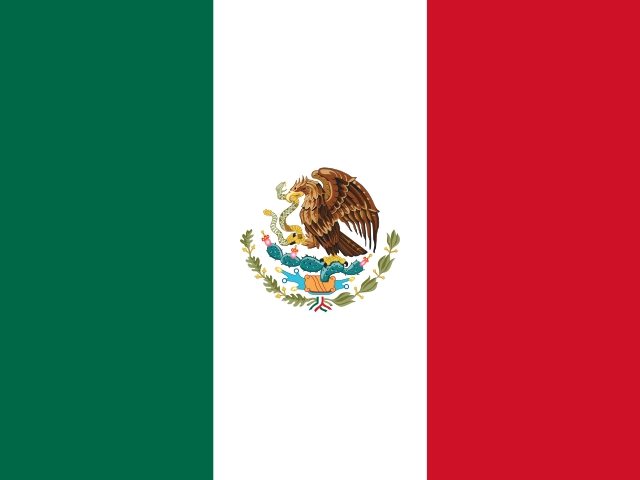
This Hispanic Heritage Month, three CFI team members share personal reflections on the families, communities and cultures that shaped their lives and helped build Colorado.
 EN
EN
TABOR might promise a government on a diet and fatter refund checks, but Colorado’s wallet feels the pinch. It’s one of the tightest tax laws in the country, quietly deciding what our state can and can’t afford. If this makes you scratch your head or mutter, “Wait, that’s fishy…” you’re in good company.
July 25, 2025
…local governments have been trying to build strong communities with a teeny, tiny toolbox?
Colorado’s Taxpayer’s Bill of Rights hands communities a tiny, broken toolbox and then expects them to build strong schools, safe neighborhoods, and thriving local economies.
Here is what is inside this tiny toolbox.
Caps on local revenue, even when needs grow
TABOR artificially limits how much revenue local governments, like school districts, cities, and counties, can raise and spend each year. Any money collected above a rigid formula, based on population growth plus inflation or new construction, must be refunded. That means even when a community grows or needs surge, local leaders cannot fully respond.
Inadequate, inflexible state-to-local grants
Because the state is also held to tight revenue caps, there is less money to share with school districts and local governments. When federal funds dry up, as they are currently under the Trump administration, which is freezing nearly $7 billion in education grants nationwide, Colorado has little wiggle room.
School districts like Denver Public Schools could lose up to $70 million, forcing cuts to programs that support English learners, migrant youth, and low-income students.
A ban on local income taxes, even if communities want them
Section 8 of TABOR makes it unconstitutional for Colorado cities and counties to adopt a local income tax, even if local voters approve it. That handcuffs communities from raising revenue in ways that are fairer and more progressive than sales or property taxes.
According to ITEP, across the country, more than 7,000 cities and counties use local income taxes to fund schools, affordable housing, and public health without overburdening low-income families.
We are missing out on tools that other states and localities can use
Just look at Maryland. Counties there can set local income tax rates between 2.25 and 3.2 percent, which fund up to 43 percent of local services. The state handles collection, making it simple for residents and efficient for local governments and allowing easier application of local refundable credits, like the Earned Income Tax Credit or Child Tax Credit. The possibilities of what this could fund are nearly endless. Montgomery County, Maryland, even has a local EITC, but TABOR means Colorado misses out on the opportunity to put money in the pockets of working families.
Or take Seattle. Its payroll tax on high earners from large corporations helps fund affordable housing, small business development, and city services. It is designed to protect small firms and low- and middle-income earners without hurting low-wage workers.
TABOR’s tiny toolbox leaves Colorado communities with broken tools and broken promises.
It is time to have a full set of tools to build a future that works for all of us.