The People Who Made Us
This Hispanic Heritage Month, three CFI team members share personal reflections on the families, communities and cultures that shaped their lives and helped build Colorado.
 EN
EN

TABOR might promise a government on a diet and fatter refund checks, but Colorado’s wallet feels the pinch. It’s one of the tightest tax laws in the country, quietly deciding what our state can and can’t afford. If this makes you scratch your head or mutter, “Wait, that’s fishy…” you’re in good company.
June 13, 2025
…Colorado’s ban on a statewide property tax has fueled massive disparities, leaving some families paying thousands more than neighbors for the same public services?
Colorado has one of the lowest effective property tax rates in the country, as shown by the Lincoln Institute of Land Policy and the Tax Foundation. Even in Denver, the tax rate on a median-priced home is roughly half that of the U.S. average for the largest city in each state. In other words, while a $500,000 home in Denver would pay about $2,600 per year in property taxes, that same home would pay $5,050 in Albuquerque, $6,300 in Minneapolis, and $11,000 in El Paso.
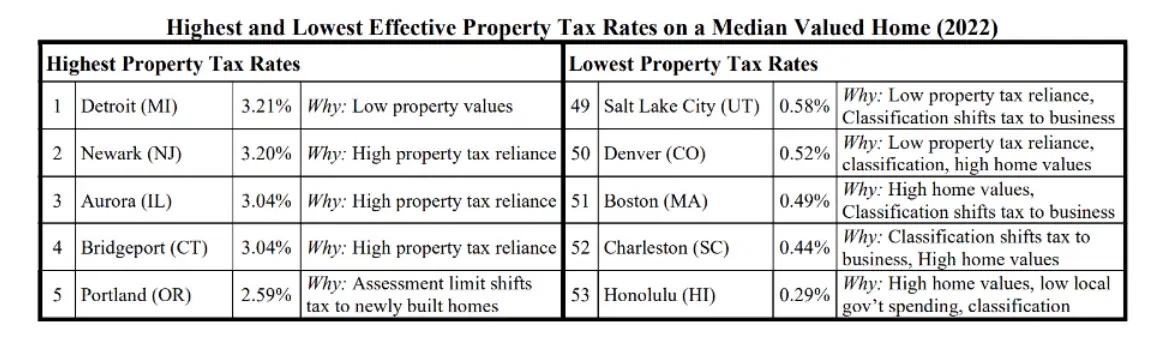
Source: 50-State Property Tax Comparison Study, Lincoln Institute of Land Policy and the Minnesota Center for Fiscal Excellence
But there are very large disparities across the state of Colorado. Consider the following example using actual data from two properties that sit within one block of each other in the Denver metro area. Both properties are three-bedroom, three-bath homes.
| Property 1 | Property 2 | |
|---|---|---|
| Value | $566,000 | $660,900 |
| Square Footage | 1,373 | 2,496 |
| Annual Property Taxes | $7,600 | $3,200 |
The annual property taxes paid by each owner flow entirely to local governments, so state taxes are not to blame for the disparity. So how is it that the larger, more valuable property pays less than half the property taxes of the other? In this instance, the first property is a new build and pays more than 60 percent of its annual tax bill to a metropolitan district, or metro district. The second property does not lie within a metro district. Instead, it pays taxes only to the City and County of Denver, the school district, and a very small mill to an urban drainage and flood control district.
When a property sits within multiple taxing authorities, it most often pays more in taxes. While this can sometimes correspond to more services, it often reflects the cost of repaying debt issued by developers to finance the property’s initial construction. As David Migoya has previously reported, because nearly all new housing development in the state occurs through metro districts, many young, first-time homebuyers are “buried in a cycle of debt generated by the builders and developers who created the metro districts where they live.”
These stark disparities in property tax burdens are partly a consequence of TABOR. A recent study by the Colorado Futures Center found that taxpayers in 74 of the state’s 178 school districts currently pay more in school property taxes than they would if TABOR had never been enacted. These districts account for 81 percent of the state’s population, 80 percent of its students, and two-thirds of the state’s total property tax base. Because TABOR prohibits a statewide property tax, the state cannot levy a uniform statewide education property tax, the revenue from which could be pooled and distributed to school districts based on equalized per-pupil spending.
The Result: A school finance system that is highly unequal, despite some equalizing transfers through the School Finance Act and state backfill formulas.
Source: National Low Income Housing Coalition, The Gap Report: Colorado Data (2025), https://nlihc.org/gap/state/co.