
The People Who Made Us
This Hispanic Heritage Month, three CFI team members share personal reflections on the families, communities and cultures that shaped their lives and helped build Colorado.
 EN
EN

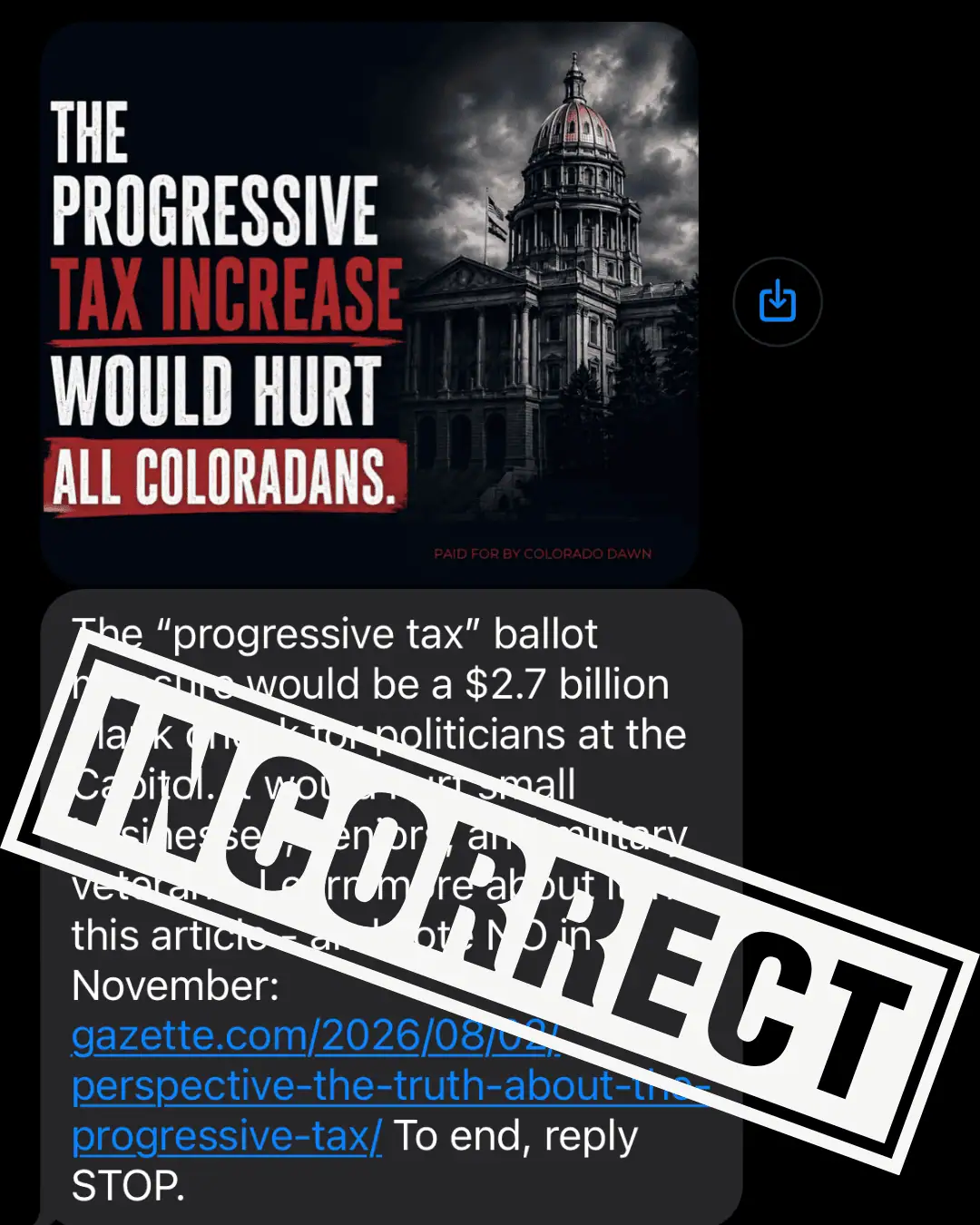
Actual text message. It’s giving Dracula, but instead of being scared by someone with fangs, we’re apparently scared of a fair tax system.
On Monday, Aug. 3, supporters of Initiative 195 delivered more than 163,000 petition signatures to the Colorado Secretary of State’s Office. The ink was barely dry before alternative facts entered the chat.
A text paid for by Colorado Dawn warned that the proposal would be a $2.7 billion blank check and would hurt small businesses, older adults, military veterans and, after apparently checking to see if they had omitted anyone, they threw in prairie dogs and all Coloradans for good measure. The claim appeared beside a darkened image of the Capitol under clouds normally reserved for Dracula’s castle. Policy analysis is all about mood lighting, apparently.
It’s also wrong.
The opposition’s argument hinges on a misreading of one constitutional edit:
Fact: The official ballot title includes a table showing average tax cuts across every income category up to $1 million.
Initiative 195 would replace Colorado’s 4.4% flat income tax with graduated brackets. The rates would be 3.7% on the first $25,000 of taxable income, 4.2% from $25,001 to $100,000, and 4.4% from $100,001 to $500,000. Higher marginal rates would begin only on taxable income above $500,000.
That matters because brackets are marginal. If a taxpayer has $600,000 in taxable income, only the last $100,000 falls into the 7.4% bracket. The first $500,000 is still taxed under the earlier brackets. No trapdoor opens beneath your accountant at $500,001.
The table in the official ballot title shows the estimated average change in taxes owed by adjusted gross income category:
| Adjusted gross income | Average change in state income tax |
| $25,000 or less | -$9 |
| $25,001 to $50,000 | -$119 |
| $50,001 to $100,000 | -$210 |
| $100,001 to $200,000 | -$298 |
| $200,001 to $500,000 | -$325 |
| $500,001 to $1 million | -$325 |
| $1,000,001 to $2 million | +$4,764 |
| $2,000,001 to $5 million | +$13,914 |
Source: Colorado Secretary of State
Unless the words ‘all Coloradans’ have been redefined to mean ‘the small fraction of taxpayers at the very top,’ this is not a close call.
Fact: Most small businesses would get the same tax cut as everyone else below the threshold.
Small business is not a tax bracket. Many small businesses are pass-through entities, meaning the owners report business income on their personal returns. C corporations file corporate returns. Initiative 195 applies the same graduated brackets to individuals and corporations, so businesses and owners with taxable income below $500,000 get a tax cut. Only income above that threshold faces a higher marginal rate.
The Bell Policy Center estimates that 95% of businesses would pay less under the proposal. A separate reality check using 2024 U.S. Census Bureau microdata found that about 333,300 of the 340,100 Coloradans reporting positive self-employment income, or 98%, had personal income below $500,000.
The scary text asks readers to picture the neighborhood coffee shop, plumbing company, or family farm being crushed by a tax aimed at income above half a million dollars. That is certainly an image. It’s not the math. Even the other Count, the one from Sesame Street, knows that 95% is most businesses.
Fact: The measure does not repeal Colorado’s tax subtractions for older adults, and nearly all Colorado older adults fall below the income threshold.
Initiative 195 changes the tax rate schedule. It does not eliminate the existing subtractions for pension, annuity, or Social Security income. Those provisions remain in state law. Age is not one of the proposed tax brackets.
The Census data are not subtle here. Of an estimated 980,600 Coloradans age 65 or older, about 976,000, or 99.5%, had personal income below $500,000 in 2024. A very high-income older adult could pay more because of very high income, not because of age. The proposal would also allow new revenue to support long-term care and other services for older adults and people with disabilities.
Fact: The measure does not repeal Colorado’s military retirement subtraction or create a special tax on veterans.
Military service is not a proposed tax bracket either. Colorado’s subtraction for eligible military retirement benefits remains in place because Initiative 195 does not amend it. The new rates apply after taxable income is calculated, including the deductions and subtractions a taxpayer is already allowed to claim.
Among an estimated 364,500 Colorado veterans in the 2024 Census data, about 361,600, or 99.2%, had personal income at or below $500,000. As with older adults, a veteran with taxable income above the threshold could pay more because that veteran is a very high-income taxpayer. Veterans as a group are not singled out.Myth: It’s a $2.7 billion blank check
Fact: The $2.7 billion figure is the maximum revenue estimate required for the ballot title, not the nonpartisan staff forecast, and the measure strictly limits how the money can be used.
The nonpartisan Legislative Council Staff fiscal analysis projects about $1.98 billion in new revenue in the first full fiscal year. The $2.7 billion number is the estimate’s maximum possible amount under the state’s forecasting rules.
Of that total, about $1.92 billion would be credited to the Colorado Future’s Account and could be appropriated or transferred only to supplement existing funding for K-12 public education, health care, and early child care and education. The remaining $64.2 million would go to the Healthy School Meals for All Cash Fund under existing law. The initiative also requires an annual public report from nonpartisan Legislative Council Staff and an audit by the Office of the State Auditor.
That is not a blank check. It’s more like a gift card that works in three departments and comes with an annual audit. Fun!
Colorado’s current tax system already favors the people doing best under it. Research from the Institute on Taxation and Economic Policy finds that middle-income Colorado households pay about 9.9% of their income in state and local taxes, while the top 1% pay about 7%.
When a proposal cuts taxes for 97% of Coloradans and opponents call it a tax increase that hurts everyone, the fear is not really about older adults, veterans, or Count Dracula swoopping down on the corner bakery. It’s about asking the small group that benefits most from the current upside-down system to pay their fair share. A flat rate may sound neutral, but neutrality is a strange word for a system in which working households pay a larger share of their income than the wealthiest.
Tax equity is not a horror movie. It means lower taxes for nearly everyone, a higher contribution from those with the greatest ability to pay, and more resources for the schools, health care, and child care Colorado families rely on.
The Capitol is not haunted. It just has a very committed filter.
Now, we know what you’re thinking. “Sure, but aren’t you an allegedly left-leaning think tank?”
Guilty as alleged. So don’t take our word for it. Look at the numbers yourself. Read the measure. Check the sources. And maybe take ominous political texts featuring dark clouds, blood-red warnings, and a heavily filtered Colorado Capitol with a grain or two of salt. Tax policy is complicated, but the math doesn’t have to be mysterious. If you have questions about Initiative 195, who gets a tax cut, who pays more, or how it actually works, ask us. We’re happy to show our work.
You can also learn more at Protect Colorado’s Future.
CCFI analysis of the U.S. Census Bureau’s 2024 one-year American Community Survey Public Use Microdata Sample for Colorado:
| Group | Estimated total | Income at or below $500,000 | Income above $500,000 |
| People age 65 or older | 980,616 | 976,152 (99.5%) | 4,464 (0.5%) |
| Age 65+ households | 611,620 | 605,011 (98.9%) | 6,609 (1.1%) |
| Veterans | 364,480 | 361,581 (99.2%) | 2,899 (0.8%) |
| Veteran households | 140,770 | 139,992 (99.4%) | 778 (0.6%) |
Source and method: CFI analysis of the U.S. Census Bureau’s 2024 one-year American Community Survey Public Use Microdata Sample for Colorado. Person and household weights were applied to the corresponding records. Income is personal income for person rows and household income for household rows. Veterans are people coded as having served on active duty in the past but not currently serving. Percentages are rounded to one decimal place. ACS income is not the same as federal taxable income or a tax filing unit, so these figures are demographic context, not a tax simulation.