The People Who Made Us
This Hispanic Heritage Month, three CFI team members share personal reflections on the families, communities and cultures that shaped their lives and helped build Colorado.
 EN
EN

A new federal housing proposal could push tens of thousands of families closer to losing their homes—including many here in Colorado. At a time when leaders continue to promise greater affordability, the latest rule from the Department of Housing and Urban Development (HUD) would do the opposite: restrict access to housing assistance, increase bureaucratic hurdles, and put stable housing further out of reach for many families.
On Feb. 19, 2026, HUD issued a Notice of Proposed Rulemaking (NPRM) that would remove mixed-status families from access to financial housing assistance if approved. Mixed-status families include both members with citizenship or eligible immigration status and those without. For example, a mixed-status family might include a mom who is undocumented, a dad who has permanent resident status, and two children who are U.S. citizens.
If finalized, HUD’s NPRM would impact more than mixed-status families. All families would face new documentation requirements, increasing administrative burdens and pushing many eligible households closer to losing assistance.
Now more than ever, with continued attacks on immigrant communities, it is essential that we urge HUD to withdraw the rule in its entirety. Using the housing crisis to scapegoat immigrants runs counter to the promise of making living affordability a reality.
Make no mistake, this is a blatant attempt to create barriers to housing for both undocumented and documented immigrant families, putting thousands of other households at risk.
“Fair housing for all, all human beings who live in this country, is now a part of the American way of life.”—President Lyndon B. Johnson said after signing legislation creating HUD.
Since its inception in 1965, HUD has supported millions of families at risk of or experiencing homelessness by increasing housing accessibility for low-income earners, older adults, and people with disabilities. Some of the supports it has historically provided include foreclosure assistance, homeownership support, help paying overdue and outstanding utility bills, public housing, and the Housing Choice Voucher program. Housing Choice Voucher programs support similar families while providing direct subsidies to private landlords.
Public housing is administered by HUD, which allocates federal funds directly to around 3,300 local Public Housing Agencies (PHAs) and sets attainable rent prices for low-income earners.
Applicants for public housing must complete a background check covering household members, family details, and income, and may be interviewed. They must also submit documentation and a signed declaration of citizenship or eligibility status. Housing agencies may request additional proof. Under current law, mixed-status families are eligible for HUD housing assistance.
If implemented, this proposal would require housing agencies to verify eligibility for every household member, making households ineligible for HUD assistance unless all members have eligible documentation status.
Furthermore, new language in HUD’s NPRM directs PHAs to report any individual without proper immigration status to the Department of Homeland Security (DHS), effectively turning public housing into a tool for immigration enforcement.
This proposal is set to disproportionately affect families, forcing many to face the choice of losing their housing assistance or separating:
The Center on Budget and Policy Priorities highlights that people receiving rental assistance are less likely to have access to the required documentation:
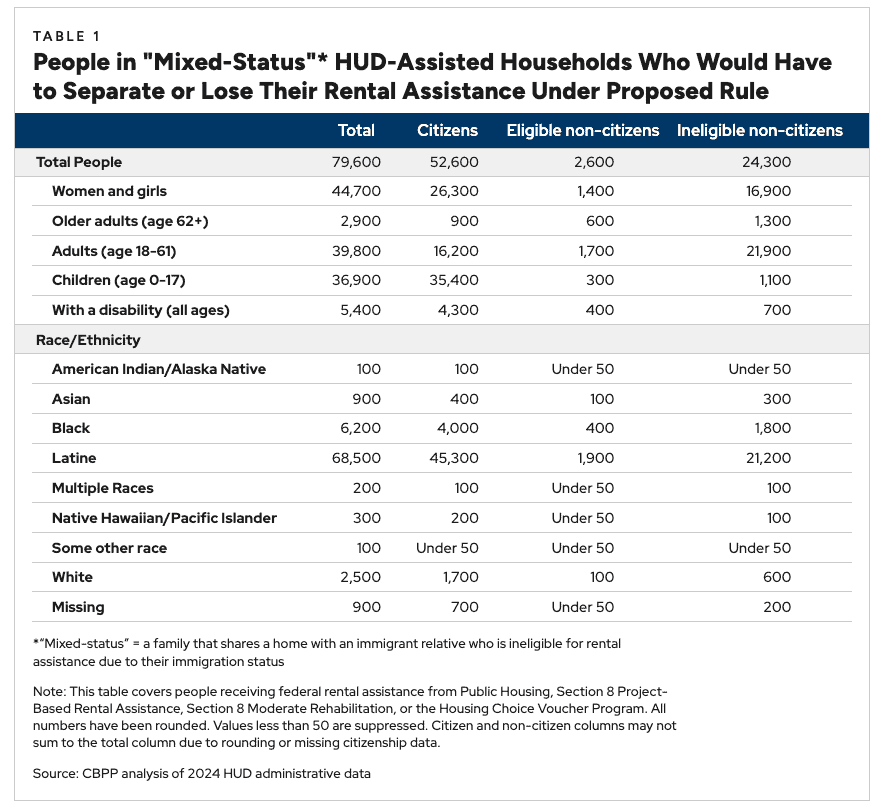
These factors demonstrate that HUD’s proposal punishes immigrant and mixed-status families, including children with citizenship, by removing services based on the immigration status of other household members. Understanding who is most affected helps illustrate how this proposal mirrors broader federal actions that push immigrants away from services and resources.
With mixed-status families removed from HUD housing assistance programs, there will be a higher financial cost to maintain the same number of housing units available. Undocumented family members are not eligible for rental assistance; therefore, mixed-status families already pay more than similar families in which all members are eligible. With limited funding for housing programs, the inability to fill that difference may cause units to sit empty, leading PHAs to lose revenue and scale back subsidized housing over time.
Additionally, increased documentation requirements create greater administrative burdens for PHAs, which are intended to focus on providing housing, not immigration enforcement. As fewer resources are available and more families lose assistance, more people will be pushed into homelessness, increasing demand for state services. People experiencing homelessness use state services at higher rates and have six times the health costs of someone who is housed. At a time when services are already strained, these pressures will continue to grow.
HUD’s proposed rule underwent a public comment period that ended on April 21, during which individuals, organizations, and community members were able to submit written input on how the changes could affect them. The agency is now reviewing those submissions as part of its decision-making process. NPRM timelines vary widely, and HUD has not announced an official timeline for a final decision.
You can view submitted public comments here:
If this proposal is approved, changes will not take effect immediately, giving current HUD recipients time to make necessary housing arrangements. Mixed-status families would have 90 days to submit proper documentation, while other families flagged for verification would have until their next annual recertification.
Stay up to date with any announcements. Join Protect Immigrant Families (PIF), a coalition of advocates working to support immigrant and mixed-status families impacted by this proposal:
Become a PIF Coalition Member
Subscribe to the PIF Coalition’s newsletter
Follow the PIF Coalition’s HUD Mixed-Families Rule campaign