The People Who Made Us
This Hispanic Heritage Month, three CFI team members share personal reflections on the families, communities and cultures that shaped their lives and helped build Colorado.
 EN
EN
TABOR might promise a government on a diet and fatter refund checks, but Colorado’s wallet feels the pinch. It’s one of the tightest tax laws in the country, quietly deciding what our state can and can’t afford. If this makes you scratch your head or mutter, “Wait, that’s fishy…” you’re in good company.
May 9, 2025
…state and local governments have come to rely more and more on revenue from fees and other charges to fund services?
Because TABOR limits revenue growth and requires voter approval for new taxes, fees, which are not restricted, have become a fiscal workaround. This has resulted in a growing number of “enterprise funds,” state-owned businesses that are exempt from TABOR so long as they collect less than 10 percent of their revenue from state and local taxes. Examples of these enterprises include CollegeInvest, Colorado Healthcare Affordability & Sustainability Enterprise, Parks and Wildlife, state nursing homes, the Statewide Transportation Enterprise, and higher education enterprises. As our colleagues at the Bell Policy Center have noted, the burden of fees typically falls hardest on those least able to pay, while a fairer tax system could meet Colorado’s needs without placing the burden on its most vulnerable residents.
Because these enterprises don’t rely to any significant degree on taxes, the services they provide must rely primarily on fees. In the case of Colorado’s 10 higher education institutions, from Adams State University to Western Colorado University, enterprise status means that state support remains incredibly low. As shown below, state and local support to higher education institutions as a fraction of those institutions’ total revenues averaged just 3 percent in 2024 and 6.3 percent in 2025.
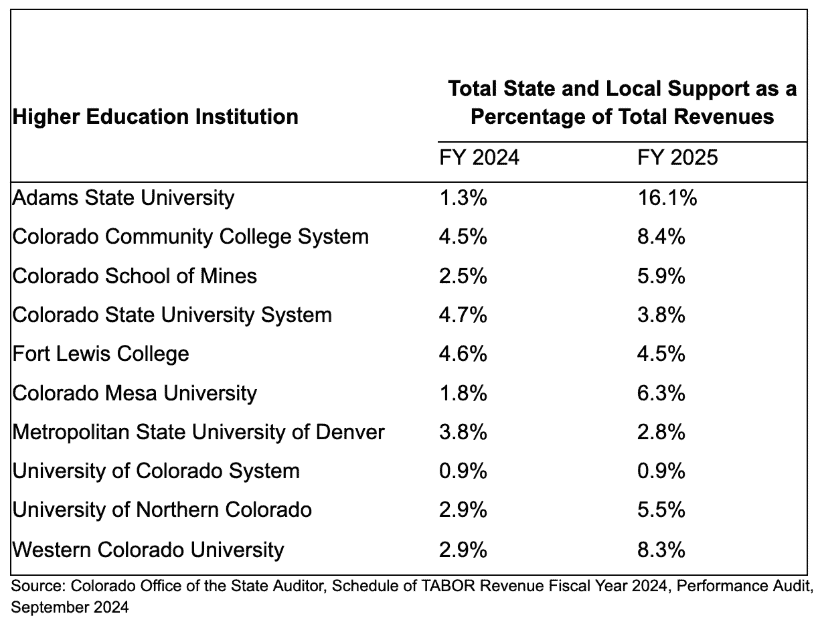
Cost to Families: With the state contributing so little to the construction and maintenance of university facilities, from classrooms to dormitories, these institutions must instead rely on debt financing, the costs of which are ultimately borne by students and their families in the form of higher tuition.
Long-Term Costs: The lack of broad, public support for Colorado’s colleges and universities has implications for affordability and access, as students bear a larger share of the cost of higher education. Without TABOR, the state could provide these institutions and the roughly 283,000 students they serve the support they deserve. And it’s not just higher education. Colorado’s extensive use of fees is a larger problem because fees are less transparent and less equitable than taxes, as they apply uniformly instead of being based on income.